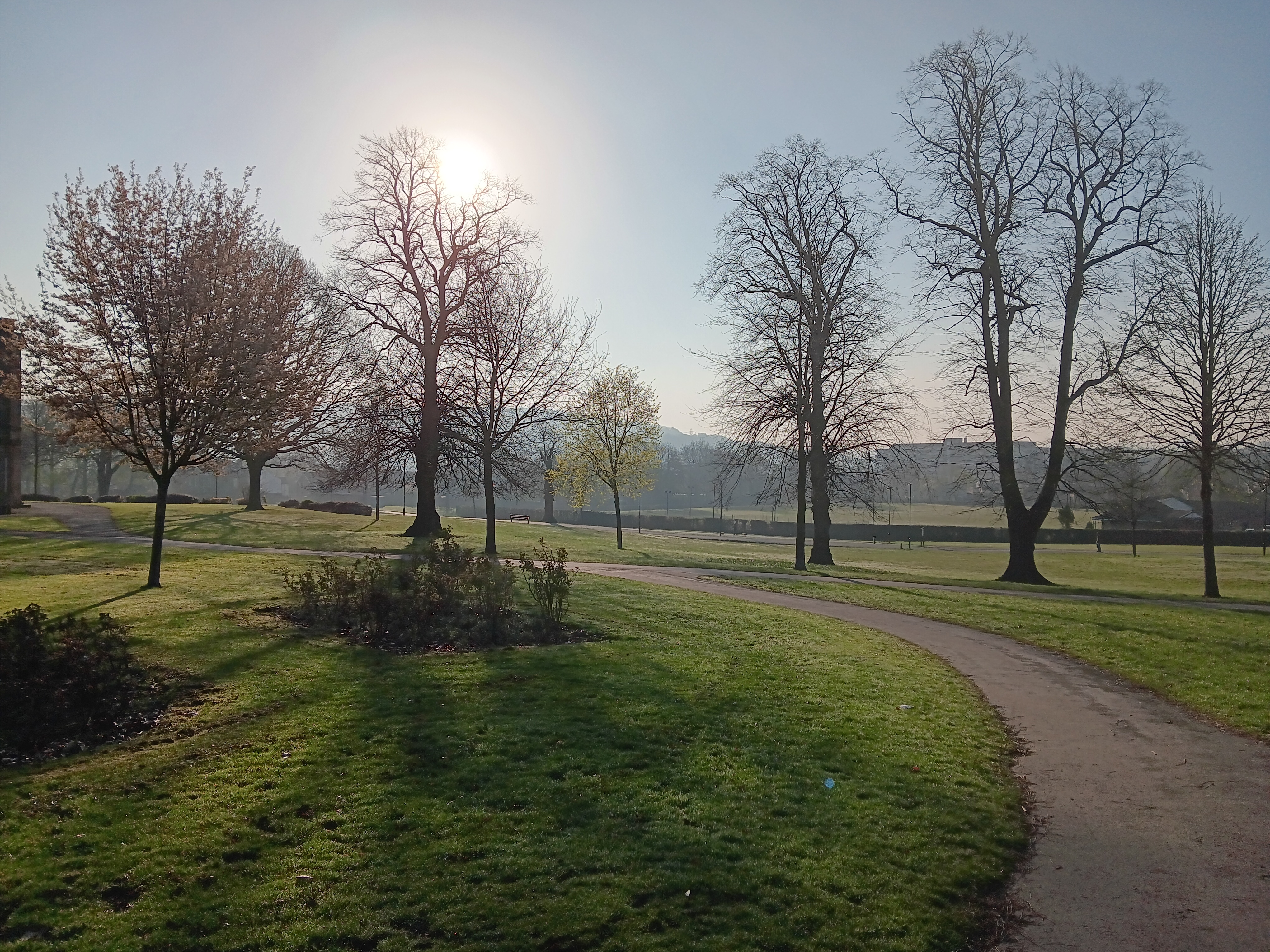
“The sign of a healthy economy should be a drinkable river.”
Li An Phoa
We talk about “the economy” as if it were a single coherent thing. In reality, it is an impossibly complicated web of interactions between billions of people, businesses, and resources.
The economy is a system. And a system is a set of interconnected elements that is organised in a way that achieves something. In other words, systems are composed of: elements, interconnection, function or purpose. (This is Donella Meadow’s definition, of Thinking in Systems fame).
Here’s my miro drawing of the main elements and interconnections of the economy:
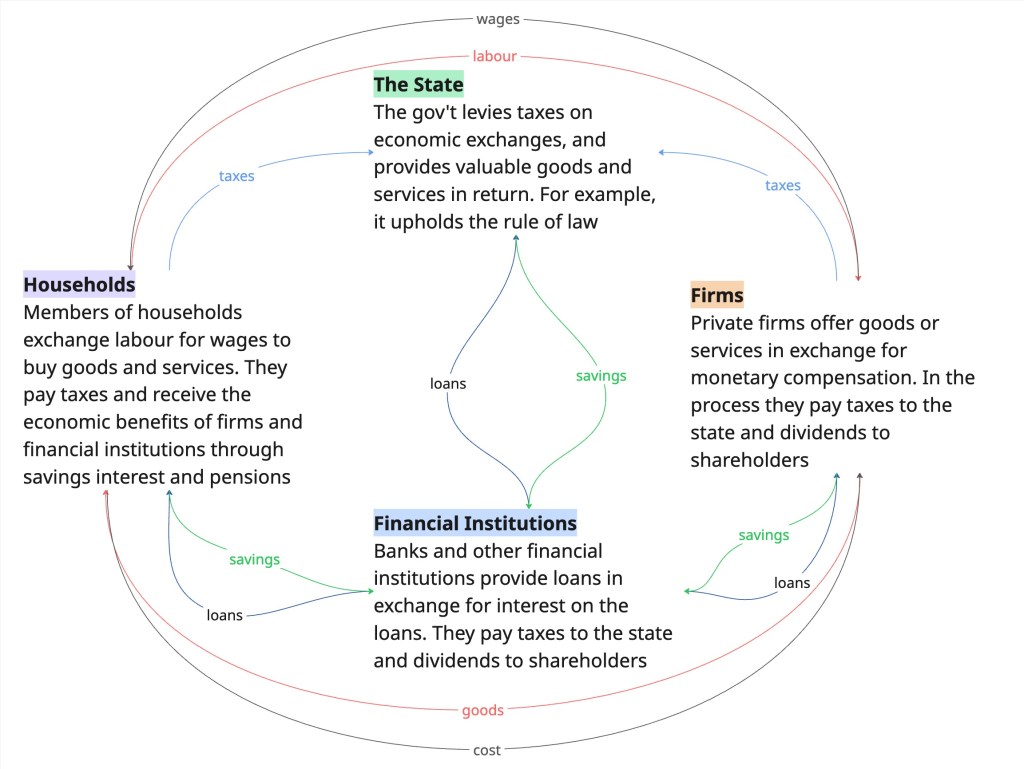
If those are the elements and interconnections, what would we describe as the function or purpose of the economy?
We can describe the economy as our system of production and exchange. We often expand this description by giving the economy a purpose of “creating value”.
“Creating value”
When working well, businesses and industries meet the needs of people while creating meaningful work and developing expertise. Financial institutions support business but providing the capital needed for innovation. Meanwhile, governance ensures there’s a level playing field, including respect of rights and responsibilities. This governance includes legislative, judicial, fiscal and monetary policy, private industry regulations, and corporate governance.
Meeting the needs of people is a good starting point for considering what “creating value” should mean. But beyond this, we need to sustain the planetary processes which are a pre-condition to the economy. These processes are captured by the concept of planetary boundaries.
The drawing above obscures the physical processes that the economic system both depends on and drives. Our economic system uses resources at an accelerating rate and follows the pattern: extract, consume, waste. Economic activity involves resources at every stage along the value-chain, whether production, transport, or consumption.
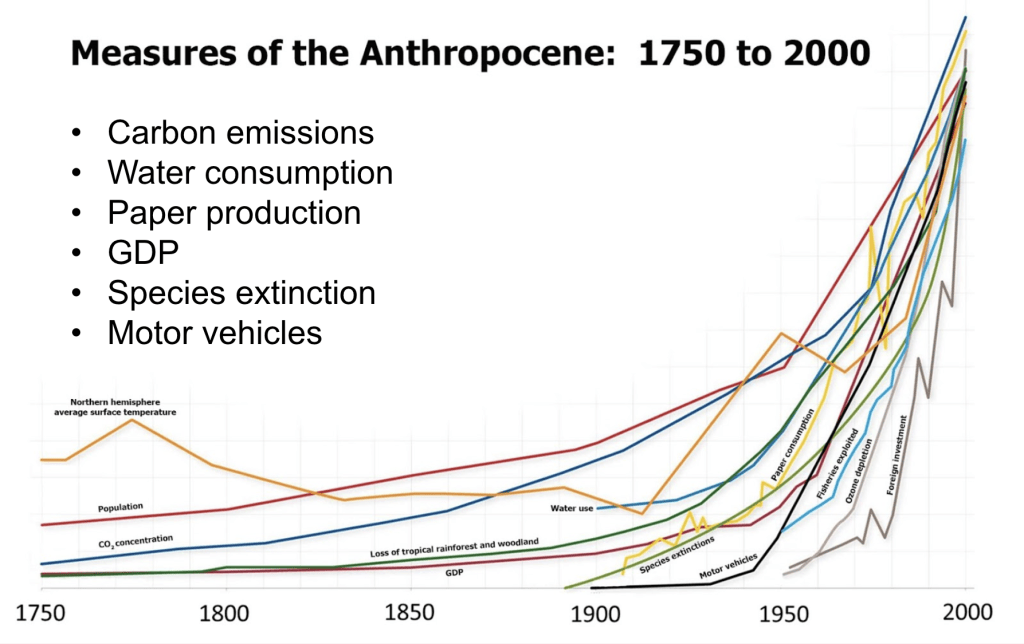
Unfortunately, most commonly value is interpreted as being equivalent to money. As a consequence, value is equated with:
- GDP (at a country level),
- Profit (at a business or investor level),
- Personal possessions (at an individual/household level)
Money, profits and short-term objectives are concerns that drive almost all decisions across the economic system. Governments look for re-election, businesses aim to impress with quarterly earnings, and as individuals we get used to the roles of “worker” and “consumer” in which money functions as a proxy of achievement, safety, and power.
In search of drinkable rivers
I read somewhere that before 1950, none of the winning UK political parties had the word “economy” in their manifestos. Our obsession with “the economy” is relatively recent.
I suspect most people don’t really know what they are referring to when they talk about “the economy”. The economy has become a catch-all concept, increasingly conflated with the financial system due to decades of financialisation – the growth of the financial sector in size, revenue and sophistication starting in the 1970s.
This confusion obscures an important truth: the economy is actually the broader, more fundamental system that encompasses all production, exchange, and human activity. The financial system, while powerful, is merely one component that should serve this larger whole.
People have a generalised awareness of economic policy decisions prioritising financial market stability over other economic concerns, and were part of the fallout of 2008. This drives a poorly understood subservience to the financial sector which cannot solve the problems in people’s lives that it is itself responsible for.
In my next post, I’ll focus on the financial system.


1 Comment