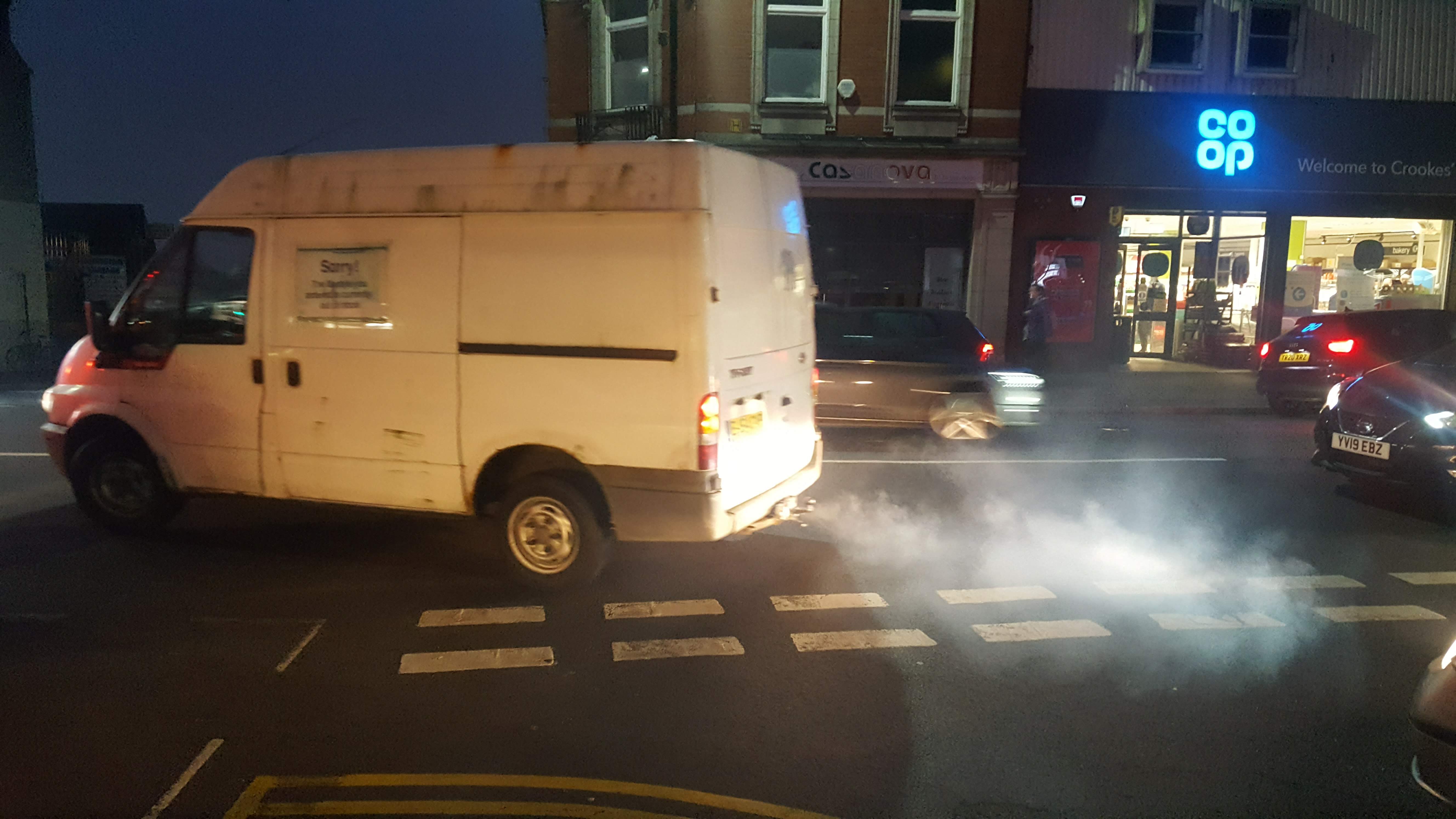
I still associate long car journeys with the excitement of going on holiday as a kid. I remember the fun of going to McDonald’s in sixth form because a friend had a car. The car was the symbol of adulthood, independence, and possibility.
Cars have lots of political and emotional attachments. We name our cars. People speak fondly of their first car. Culturally, cars mean freedom. Learning to drive is as close to a Western rite of passage as we have now.
And yet, since leaving home, I’ve slowly fallen out of love with cars. I now think of our relationship with cars as one of the most profound opportunity costs of modern life. By choosing private vehicle ownership, we’ve traded away alternatives we can barely imagine anymore.
So, for the still-enamoured, here are are ten things I hate about cars.
1. Inefficient: 96% parked
The average car sits unused 96% of the time (RAC). We move people around in their own 1.5-tonne metal boxes that spend almost their entire existence doing nothing. From a resource allocation perspective, this is staggering.
I couldn’t believe car utilisation was so low. I only came across this fact because of a comparison with truck “utilisation rates”. Trucks sit unused 30% of the time. Whereas the car industry is reliant on emotional, irrational purchasing, businesses invest in trucks as tools. (“No one buys a truck because of a mid-life crisis”.)
These parked cars take up a huge amount of space. When making the game SimCity, the game makers tried to use real-world measurements, but came unstuck with car parks. (“…there were way too many parking lots in the real world… our game was going to be really boring if it was proportional in terms of parking lots.” (Atlantic))
This car ad famously demonstrates this inefficiency:
2. Enormous: size inflation
Cars keep getting bigger. SUVs (sports utility vehicles) now make-up almost half of new car sales. The average mass of new cars is 15% above 2001. (Sustrans)
This isn’t driven by need – families haven’t grown correspondingly larger. It’s mostly driven by the profit margins automakers make on larger cars (but maybe this is for another time).
I’ve heard families tell me that they need an SUV because they need the room and it feels safer. SUVs are dangerous. If you are driving an SUV and are in an accident involving a child, they are eight times more likely to die. (Sustrans) You don’t want to be in a car accident thinking that your desire for a larger car might be the reason you’ve killed someone.
3. Polluting: toxic boxes
Transportation is the major driver of oil demand globally. While electric vehicles are already displacing 1.5 million barrels of oil a day (Bloomberg), transport still accounts for 23% of global energy-related CO2 emissions, with 70% of that coming from road vehicles (IPCC, p1674).
It’s not just climate change. Cars damage ecosystems, consume resources, and worsen natural disasters. Meanwhile, roads fragment habitats, create edge effects, and act as barriers to animal movement. More than any other factor, road expansion determines “the pace and patterns of habitat disruption and its impacts on biodiversity.” (IPCC, p1171)
The sprawling, car-dependent development that roads enable also makes natural disasters worse. Impervious surfaces increase flooding, while the “heat-island” effects of urban road surfaces worsens the impacts of severe heat. As the video title above says “Car-dependency is HOT”.
4. Deadly: 1 in 34 deaths
If any other consumer product killed people at the rate cars did, we’d demand immediate action.
Traffic crashes kill 1.3 million people annually – that’s 3,500 people every single day. It’s the eighth leading cause of death worldwide, and the leading cause of death for children over 4 and adults under 30. More than 700 children are killed in traffic crashes every day (Science direct).
Since cars were invented, they’ve killed an estimated 60-80 million people. That’s comparable to the combined death toll of both World Wars (Science direct).
The human cost extends beyond direct casualties. Traffic noise affects sleep, stress levels, and mental health. Air pollution contributes to cardiovascular disease and cognitive decline, and is itself a major cause of death. We’ve externalised these costs so completely that we barely account for them.
This is only human deaths. Vertebrate deaths from road traffic are difficult to count, but the global number is likely greater than 1 billion per year (Science direct).
5. Violent: cars as weapons
We resist thinking of cars as weapons, but the violence cars engender is not accidental. It’s an obvious outcome of a system which equips people with high-speed metal projectiles. Vehicle ramming attacks have become so common that hundreds of cities have installed bollards to fortify public spaces.
Cars enable drive-by shootings and provide convenient methods for self-harm through carbon monoxide poisoning or intentional crashes. In the US, traffic stops – the most common police-citizen interaction – have become a setting for state violence, particularly against Black, Latino, and Indigenous people. (Carbado, 2015) Meanwhile, aggressive driving, road rage, and driving under the influence harms thousands annually.
This violence is culturally embedded in how we talk about cars. Marketing departments sell vehicles with language like “military-grade aluminum,” “tactical,” “assault”. Cars have names like the Ford F-150 Raptor, Dodge Ram, Jeep Commander. This militaristic branding taps into “petromasculinity” – the fusion of fossil fuel dominance with aggressive masculinity. (Daggett, 2018)
The violence extends globally through the resource extraction of the wider industry. Cars consume about half of all oil production, and one study found that 25-50% of interstate wars since 1973 have been connected to oil access. (Colgan, 2013) From Nigeria to Iraq, blood has been spilled to keep motorists driving.
6. Excluding: designed for able men
Cars do help some people with disabilities navigate the world more easily. But we’ve used this fact to justify designing everything around car access. Car-centric design is frequently inaccessible. Many disabilities prevent people from driving. And, because car ownership is correlated with income, and you are more likely to be low-income if you are disabled, many disabled people can’t afford a car.
Car harm is not evenly distributed and has both racial and gendered dimensions. For example, a US study found that people were less likely to stop their cars for Black pedestrians than for white pedestrians (Science Direct). And when a woman is involved in a car crash, she is 47% more likely to be seriously injured than a man (C Perez). Similarly, despite lower levels of car access and higher levels of public transport use, people with disabilities are also more likely than others to be killed or injured by cars (Transport Statistics).
7. Isolating: “urban mountain ranges”
Car dependency has fundamentally altered how communities function. When daily life requires driving everywhere, public space becomes transit space rather than social space. Traffic restricts social interaction, with research showing that people living on busy roads are less likely to know their neighbours (Hart, 2008).
One of the main groups impacted by the ‘unfreedom’ of cars is children. There has been a massive drop in the physical geographical freedom and independence we allow children to have. While there are multiple contributing factors, across the last 70 years, UK car traffic has massively increased. In 1950 there were 2 million cars (RAC). In 2024 there were 41.7 million (DfT).

8. Expensive: 90% on finance
Car ownership is a major part of the UK’s debt economy, which I’ve written about before. 90% of new cars are bought on credit (Which?).
Car ownership strongly correlates with income. For those living on the very lowest incomes, the running costs of keeping a car can exceed a fifth of their weekly income (IPPR). It’s these same households who are most affected by air pollution.
Back in 1974, Austrian philosopher Ivan Illich wrote ‘Energy and Equity’ in which he calculated that the “typical American male” spent 4 out of 16 waking hours either driving or working to pay for his car. That’s a quarter of conscious life dedicated to a machine that sits unused 96% of the time.
Beyond the huge social and environmental costs of cars, private car ownership exerts enormous financial pressure on individual households. Most people vastly underestimate the total cost of their car ownership too.
9: Pervasive: motonormativity
I remember thinking it was a bit OTT when I first met someone who didn’t like cars. It made about as much sense to me as someone who didn’t like buildings, or pavements or lampposts. I saw cars as functional, and functional things I saw as good.
I didn’t think about cars because they were pervasive to the point of invisibility. As I was preparing to write this I was fairly confident that there must be a dozen articles and blog posts which list ‘x things I hate about cars’, and so I had a quick google. …
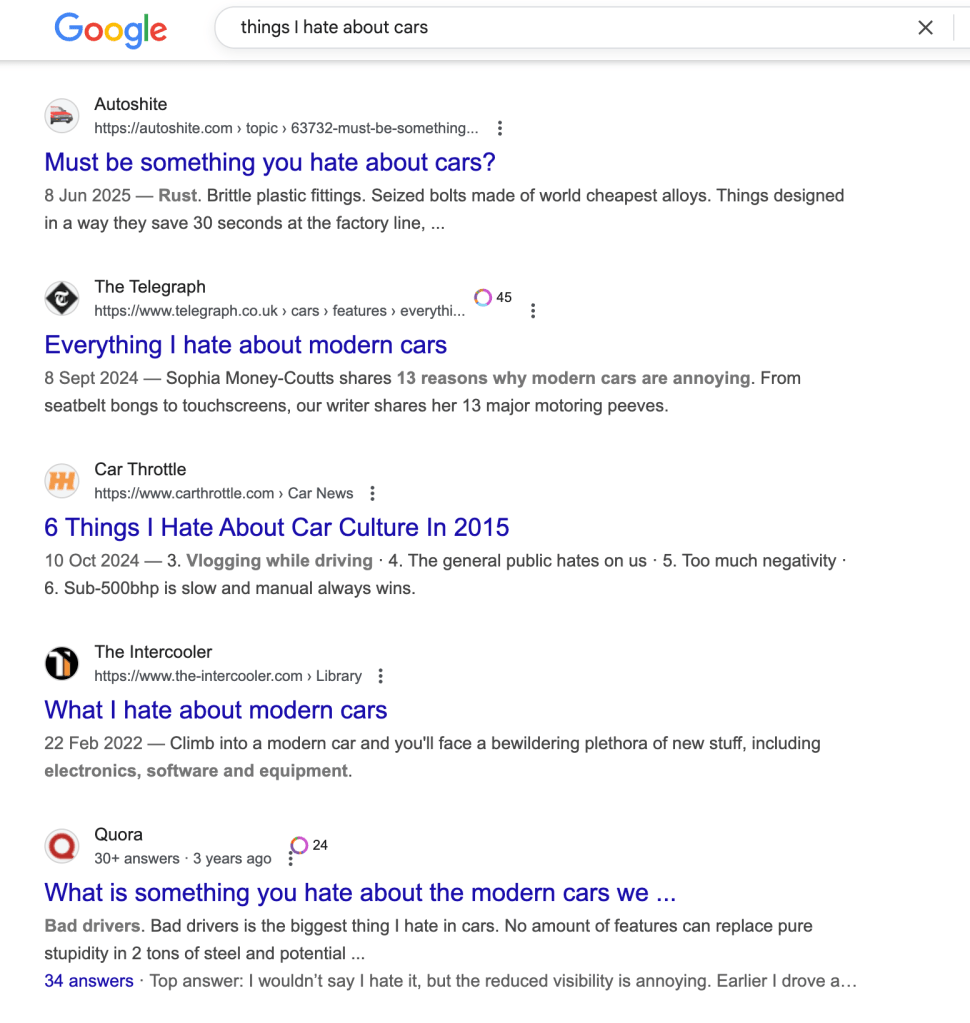
Alas! In a direct demonstration of motonormativity (the assumption is made that car ownership and use is an unremarkable social norm), I was offered lots of gripes about cars from the perspective of car owners and drivers, and no actual critique of car ownership and use itself…
10: Expansionary: here come the SDVs!
In spite of everything, automobility continues its expansion into the 2020s.
The future of cars is electric. (Thank goodness!) I am asked frequently whether electric cars “are really better”. Yes, yes they are! We can’t end our dependence on fossil fuels without shifting to electric.
Of course, better than an electric car is no car at all… Electrifying our transport requires a massive expansion of our renewable energy capacity. This can and should be done. And there’s a real risk that we increase energy demand as we transition – replacing existing forms of shared mobility in places where this is the norm with privately-owned electric mobility.
The automotive industry has no incentive to pursue forms of shared mobility and will expand into new markets wherever possible. Tesla has provided the blueprint for transitioning – producing premium tier electric models and using these profits to (gradually) make more mass-market models. (This is a great method if your primary aim is to proliferate the harms of big electric SUVs…)
Tesla are also the pioneers of the SDV, the software-defined vehicle. This means they can update vehicles without the need to recall them. It’s the direction of the whole industry. Drive a car with a 2025 plate, and you’ll likely be confronted with an in-built tablet, as in the video below.
The issues of obsolescence which arrive when you digitise what has been mechanical, might be a topic for another time! For now it’s enough to tell you that this move is not based on the greater good. It used to be that the critique of renewable energy was that it was too expensive. Now the worry is that it is so cheap that the margin of profitability continues to make fossil investment more attractive. It’s similar in the automotive industry – why solve for an accessible, equitable, green shared mobility solution if a premium, private, digitised solution has greater potential for the bottom line?
Another world is possible!
I don’t write this to shame you if you drive. I don’t own a car, and have had to be intentional about setting my life up in a way that makes that choice possible. I also still drive on occasion (though I can’t do so without some cognitive dissonance!). We have organised everything around private car ownership to such an extent that it’s not straightforward not to drive.
I write this mostly to encourage you to examine your own “motonormativity” assumption. Cars don’t give us the freedoms we ascribe to them, but the bias towards car ownership and use is almost hardwired at this point. An affordable, accessible, integrated, green public transport system is what we should be pushing for.
Oh, and please don’t buy an SUV.
 thejoyofrachel
Rachel,
Thank you for “Ten Things I hate about cars”.
Excellent. A load of good points.
Great point about Sheffield generations!
Andrew [Basden]
LikeLike